
What Is SEO? How does it work?
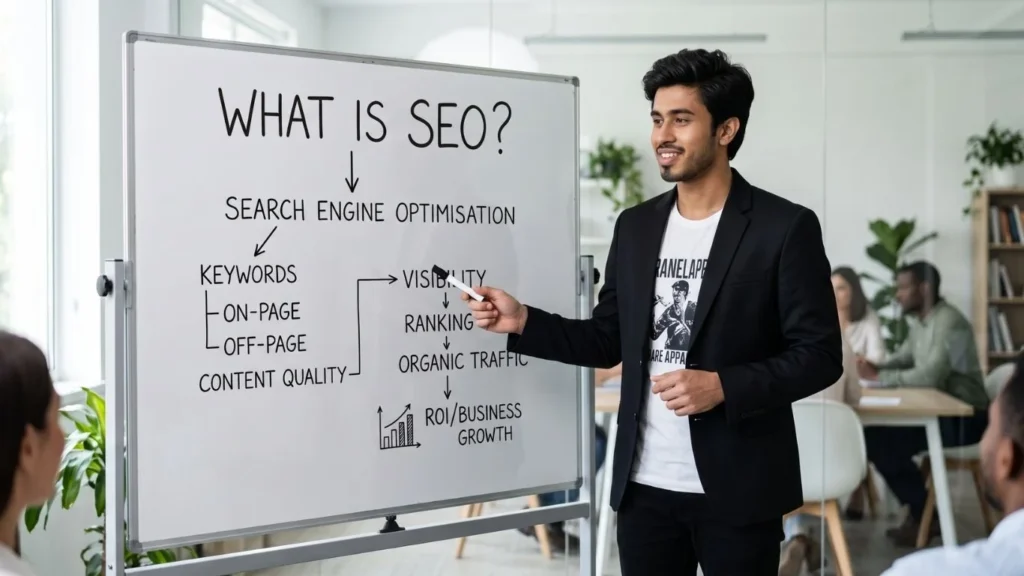
SEO is the work that helps your website show up when someone searches for a service, product, or answer you offer. It works by helping Google find your page, understand what the page is about, and show it to the right person when the search matches.
A website can look professional but still bring no calls, leads, or sales from Google. This usually happens when the page does not clearly say what the business offers, who it helps, where it serves, or why someone should trust it. Brands like Brandingdask fix these weak points through SEO. SEO fixes these weaknesses by making websites clearer, more user-friendly, and better optimised so visitors can quickly understand the value of a business.
For a small business, SEO helps you get found by people who already need your service. It makes your content clearer, your pages easier to read, and your website stronger for actions like calls, bookings, quote requests, and sales.
What Is SEO?
SEO stands for Search Engine Optimisation. It is the process of making your website clearer, stronger, and more useful so search engines can match your pages with people searching for related products, services, or information.
SEO is not only about adding keywords to a page. It also includes writing helpful content, using clear headings, improving page speed, fixing technical issues, adding internal links, building trust, and making the website easy for visitors to use.
The main goal of SEO is to bring organic traffic without paying for every click. For a business, good SEO helps the right people find your website, understand what you offer, trust your brand, and take action such as calling, booking, asking for a quote, or buying.
How Does SEO Work?
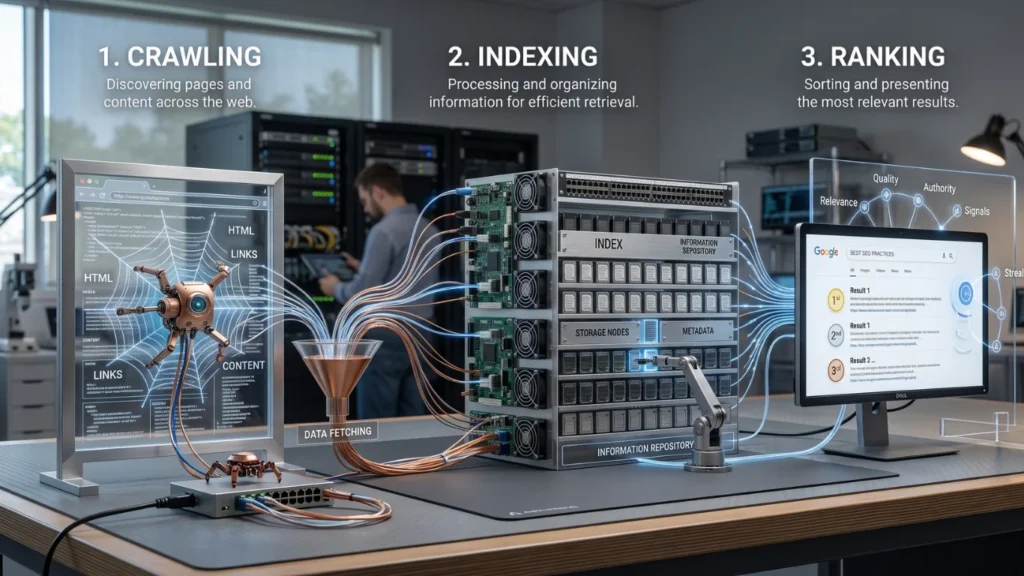
SEO works by helping search engines discover your pages, understand the content, and show the right page when someone searches for a related topic, service, or product. Google Search works in three main stages: crawling, indexing, and serving results.
First, Google needs to find your page. This usually happens through links, sitemaps, or pages Google already knows. Then Google reads the page, checks the text, images, links, and structure, and stores important information in its index. When someone searches, Google looks through that index and chooses the pages that best match the search.
This is why SEO is not only about writing content. Your page needs clear headings, useful answers, internal links, crawlable pages, fast loading, mobile-friendly design, and strong trust signals. These details help Google understand your page better and help visitors decide whether your business is the right choice.
Step 1: Crawling
Crawling means Google discovers your pages.
Google uses automated programs called crawlers to visit web pages, read their content, and follow links to find more pages. For example, if your homepage links to a new blog post, Google may find that blog post by following the link from your homepage.
Crawling is not a one-time job. Google may come back to pages it already knows to check whether the content has changed, updated, or been removed.
This is why your website structure matters. If important pages are not linked properly, blocked by robots.txt, hidden too deeply, or connected through broken links, Google may struggle to reach them. Before blaming keywords or content, first check whether Google can actually find and access the page.
Step 2: Indexing
Indexing means Google reads your page and stores important information about it.
After crawling a page, Google tries to understand what the page is about. It looks at the text, headings, images, videos, links, language, and canonical signals. If the page is clear and useful, Google may add it to its index. This index works like Google’s large library of web pages.
But indexing is not guaranteed. A page may not be indexed if the content is copied, very thin, blocked from crawling, confusing for Google, or too similar to another page on your website.
So publishing a page is not enough. The page needs a clear topic, original value, proper internal links, and a structure that helps Google understand why the page should be stored and shown in search results.
Step 3: Ranking
Ranking means Google decides which indexed pages should appear for a search and in what order.
When someone types a search query, Google checks its index and compares many pages. It looks at how closely the page matches the search, how useful the answer is, how easy the page is to use, whether the source looks trustworthy, and whether location or user settings matter for that search.
This is where many pages lose visibility. A page may have the right keyword in the title, but that alone is not enough. If the content does not answer the search properly, the page loads slowly, the layout is hard to read, or the website has weak trust signals, Google may choose another page instead.
Good ranking usually comes from a mix of clear content, strong on-page SEO, fast and mobile-friendly pages, helpful internal links, quality backlinks, and real trust signals. In simple words, Google wants to show the page that best fits the search and gives the user the easiest path to an answer.
Why User Intent Matters in SEO
User intent means the real purpose behind a search.
A person searching “what is SEO” is probably trying to understand the basics. But someone searching “SEO agency in Dhaka” is closer to hiring a service provider. Both searches are about SEO, but they do not need the same type of page.
This is why SEO starts before writing. You need to understand what the searcher wants at that moment. Do they want a quick answer, a step-by-step guide, a price idea, a comparison, or a business they can contact?
When your page matches that need, people stay longer, read more, and take action more easily. But if the page gives the wrong answer, even the right keyword will not help much.
Before writing any SEO page, ask this simple question: What is this person trying to solve right now?
The 3 Main Parts of SEO
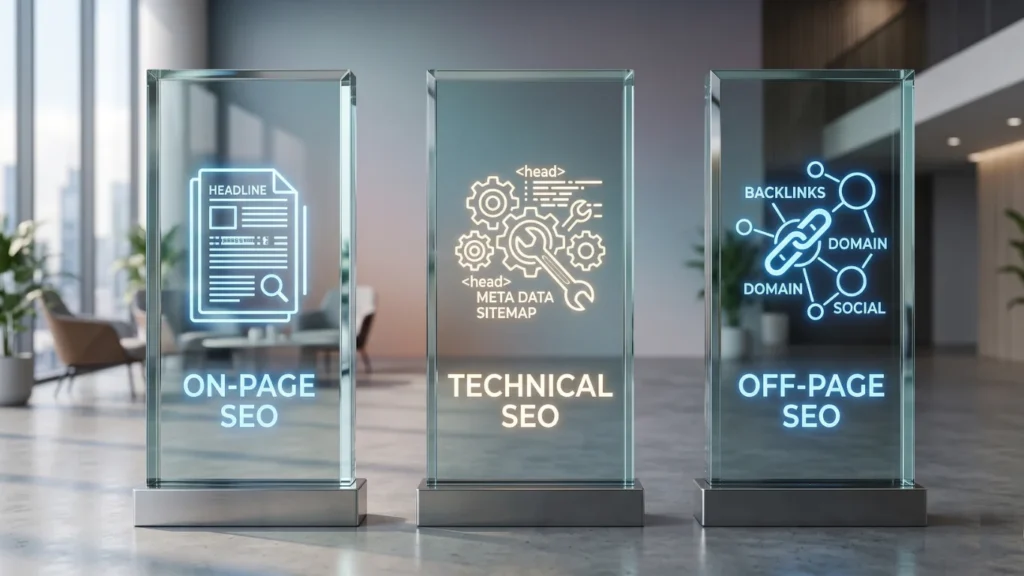
SEO has three core pillars: on-page SEO, technical SEO, and off-page SEO. These three parts work together to help search engines understand your website, trust your website, and show it to the right people.
1. On-Page SEO
On-page SEO is the work you do on the page itself.
It includes your page title, H1, headings, intro, body content, images, FAQs, internal links, and keyword placement. The goal is not to repeat keywords too much. The goal is to make the page clear, useful, and easy to follow.
A strong on-page SEO page answers the main question early. Then it explains the topic in a simple order so both Google and readers can understand the page quickly.
2. Technical SEO
Technical SEO is the behind-the-scenes work that helps search engines crawl, understand, and index your website.
It includes page speed, mobile usability, clean URLs, sitemap, robots.txt, canonical tags, structured data, broken links, and crawl access. These things may not always be visible to visitors, but they can affect how well your website performs in search.
A website can look professional but still struggle on Google if it is slow, messy, or hard to crawl. Technical SEO makes sure your website has a strong foundation before you expect better rankings.
3. Off-Page SEO
Off-page SEO is the work that builds trust outside your website.
It includes backlinks, brand mentions, reviews, citations, partnerships, and other signals that show your business is trusted by others. Backlinks are important, but quality matters more than quantity.
A link or mention from a real, relevant website is stronger than many weak links from random sites. Good off-page SEO helps Google see your website as more reliable in your topic or industry.
In simple words, on-page SEO helps your page make sense, technical SEO helps Google access it, and off-page SEO helps build trust around it.
Why Local SEO Matters for Local Rankings
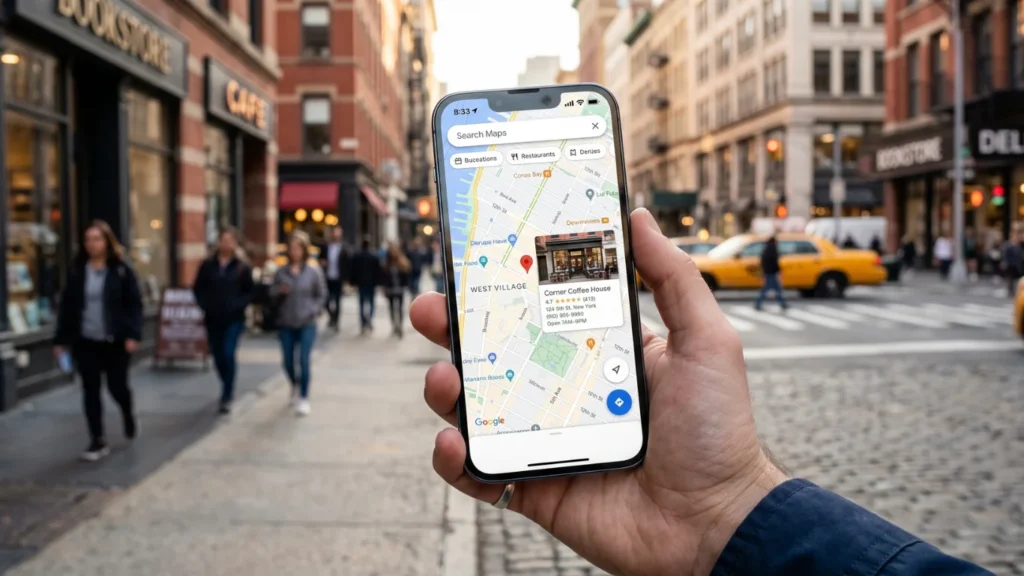
Local SEO helps your business rank when people search for services in a specific city, area, or nearby location.
For example, someone may search “SEO agency in Dhaka,” “dentist near me,” or “plumber in New York.” These people are not just reading for information. Many of them are ready to call, visit, book, or ask for a quote.
That is why Local SEO is important for small businesses. It helps Google understand what your business does, where you serve, and why local customers should trust you.
Local SEO includes Google Business Profile optimisation, customer reviews, local keywords, NAP consistency, local citations, service area pages, location pages, and local content.
In simple words, Local SEO helps nearby customers find your business when they already need your service.
Modern SEO: AEO and GEO
The 3 Main Parts of SEO build the SEO foundation. But modern SEO also needs AEO, and GEO because people now search through Google, maps, voice search, and AI answers.
AEO means Answer Engine Optimisation. It helps your content appear in featured snippets, People Also Ask, voice search, and direct answer results. AEO works best when your page gives clear answers early, uses simple headings, adds FAQs, and solves one question at a time.
GEO means Generative Engine Optimisation. It helps AI tools understand your brand, services, location, and expertise. GEO includes clear brand information, schema, entity signals, trusted mentions, expert content, and helpful answers.
In simple words, Local SEO helps nearby customers find you, AEO helps your content answer questions directly, and GEO helps your brand become visible in AI-powered search.
How Does Google Order and Rank Search Results?
Google ranks search results by choosing which pages best match a search and then ordering them based on usefulness, relevance, trust, and user experience.
When someone searches on Google, Google first tries to understand what the person means. It does not only look at the exact words. It also looks at the topic, possible meaning, location, language, and search context. For example, a search for “coffee shop” in Dhaka needs local results, not a general article about coffee.
After that, Google checks its index to find pages that match the search. A page with the right keyword can help, but keyword use alone is not enough. The page also needs to answer the search clearly, cover the topic properly, and give the user what they expected to find.
Google also looks at quality and trust. Pages with real experience, clear information, useful details, strong reputation, and reliable signals have a better chance of performing well. This is why copied, thin, or surface-level content often struggles.
User experience matters too. If a page loads slowly, looks bad on mobile, is hard to read, or makes the answer difficult to find, users may leave quickly. A better page gives the answer fast, explains it clearly, and makes the next step easy.
In simple words, Google does not rank a page only because it has keywords. It ranks pages that match the search intent, provide a useful answer, come from a trusted source, and give people a smooth experience.
Google also uses complex systems to understand and organise information across the web, a process known as web search.
Conclusion
SEO is not about tricking Google. It is about making your website clear for search engines and useful for the people who visit it.
When your page answers the right question, loads fast, connects to helpful pages, and shows real proof, it has a stronger chance to bring traffic, calls, and leads. The best place to start is with the basics: match search intent, improve weak content, fix technical issues, add internal links, and track the actions that matter.
If your website is live but still not bringing results, there is usually a reason behind it. A free SEO audit can show what is blocking your growth and which fixes should come first.
Frequently Asked Questions
Is SEO free?
SEO clicks from normal Google results are unpaid. You do not pay Google for each organic click. But SEO work is not free because it needs time, content, technical fixes, keyword research, and tracking.
How long does SEO take?
SEO usually takes time. Some small changes may show faster, but bigger results can take several months. Google also says some SEO changes can show in hours, while others may take months. Source: Google SEO Starter Guide.
Can small businesses do SEO?
Yes, small businesses can do SEO. Start with clear service pages, buyer keywords, Google Business Profile, reviews, and basic technical fixes. You do not need a huge website to start.
What are the 3 main parts of SEO?
The three main parts of SEO are on-page SEO, technical SEO, and off-page SEO. On-page SEO improves your page content. Technical SEO helps Google crawl your site. Off-page SEO builds trust through links and mentions.
Is SEO better than paid ads?
SEO and paid ads do different jobs. SEO builds organic visibility over time. Paid ads can bring faster traffic, but the clicks usually stop when the budget stops.
Does SEO still work in 2026?
Yes, SEO still works in 2026. Search is changing because of AI Overviews and AI search, but Google says improving content for generative AI search is still SEO. Source: Google AI Optimization Guide.
What is local SEO?
Local SEO helps your business show up when people search in your area. It includes Google Business Profile, reviews, local pages, NAP details, photos, and local proof. This matters a lot for service businesses.
What is technical SEO?
Technical SEO helps Google crawl, index, and understand your website. It includes site speed, mobile usability, sitemaps, canonical tags, structured data, clean URLs, and fixing broken pages.
What is AEO/GEO?
AEO means answer engine optimisation. GEO means generative engine optimisation. Both focus on making your content clear enough for AI answers, AI Overviews, featured snippets, and answer-style search results.