
In 2026, on-page SEO in Bangladesh focuses on user-first content, E-E-A-T signals, and AI-friendly structure. So you need a simple checklist that improves mobile UX, page speed, and clear headings.

If you search “On-Page SEO Checklist in Bangladesh 2026,” you want a step-by-step workflow to optimize one page for rankings and clicks. This guide covers intent, short URLs, the primary keyword in the first 100 words, title, and meta for CTR, clean H1–H3 structure, internal links, JSON-LD schema, and Core Web Vitals. Apply it in 30–60 minutes, then measure in Search Console and GA4.
Key Takeaways
- First, map one primary keyword to one clear intent and one URL.
- Next, write human-first content and add simple E-E-A-T signals on the page.
- Then, keep your title under ~60 characters and your meta under ~160 when possible to support CTR.
- After that, use one H1 and a clean H2/H3 structure so readers can scan fast.
- Also, add helpful internal links and 1–2 trusted external links for clarity and trust.
- Finally, use JSON-LD schema and improve Core Web Vitals on mobile for a better page experience.
What Is On-Page SEO in 2026? (Checklist Basics)
On-page SEO means the work you do on a webpage to help it rank and earn clicks in Google Search. So it includes your content, title tag, meta description, headings, internal links, images, schema markup, and page experience signals like Core Web Vitals.
In 2026, Google AI Overview and voice search often pick short answers from clean, easy-to-scan pages. That’s why you should use quick answers, clear headings, and simple steps.
Finally, follow one rule: one page = one main topic + one primary keyword + one clear intent. Blogs usually serve informational intent, while service pages often need transactional details like pricing, process, and contact steps—see SEO services in Bangladesh.
Quick On-Page SEO Checklist Table
| Area | Must-Have in 2026 |
| Intent + keyword | One primary keyword is mapped to one intent |
| Content quality | Human-first writing + E-E-A-T signals |
| Title + meta | Unique, clear, click-friendly |
| URL | Short, clean, descriptive slug |
| Headings | One H1, clean H2/H3 flow |
| Links | Internal links + 1–2 trusted external links |
| Schema | JSON-LD: Article, FAQ, Organization/LocalBusiness |
| Speed | Core Web Vitals targets and quick fixes |
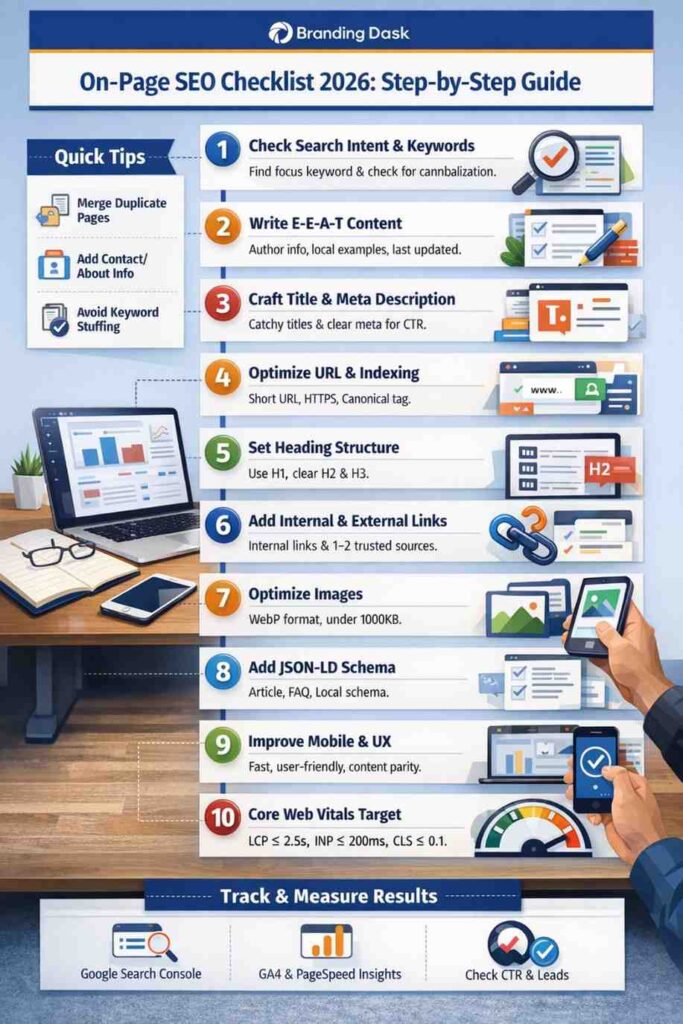
On-Page SEO Checklist 2026: Step-by-Step Guide
Step 1 — Confirm intent and pick one keyword
Start with the searcher goal. This topic signals a practical checklist, so your page must stay task-based.
Use a simple keyword set:
- Focus keyword: On-page SEO checklist 2026
- Close variants: on-page SEO audit checklist, on-page SEO best practices 2026
- Bangladesh modifiers (use only when needed): Bangladesh, Dhaka, Chattogram, Sylhet, “near me”
- Bangla-English mix (use lightly): on page SEO checklist bangla, SEO checklist Bangladesh
Fast cannibalization check (5 minutes):
- Search: site:yourdomain.com on-page SEO checklist
- If two pages target the same intent, keep one as the main page.
- Next, merge, overlap, or change the weaker page angle.
- Then add internal links to the main page.
Step 2 — Write human-first content with E-E-A-T signals
Google rewards pages that help real people finish a task. So write in your own voice, add clear steps, and use details you can support.
Add E-E-A-T signals on-page:
- Author name + role, plus a “Last updated” date
- Tools used (Google Search Console, GA4, PageSpeed Insights)
- Local examples for Bangladesh audiences (agency, clinic, education, local services)
- A clear Contact/About path for trust
Step 3 — Write title tag and meta description for CTR
Better CTR can bring more traffic, even when rankings stay stable. So write your snippet like a promise and match the page intent.
Title tag rules:
- Keep under 60 characters when possible
- Put the primary keyword near the start
- Write one unique title per page
- Add a location word only when the page targets local intent
Meta description rules:
- Keep under 155–160 characters when possible
- State value in one clear line
- Add a simple action line
Copy-ready title ideas:
- On-Page SEO Checklist (2026): Bangladesh Fast Guide
- On-Page SEO Checklist (2026): 30–60 Minute Page Fix
- On-Page SEO Checklist (2026): Improve CTR and Leads
Copy-ready meta ideas:
- “Use this on-page SEO checklist 2026 to improve rankings, CTR, and indexing in Bangladesh. Follow a 30–60 minute workflow for any page.”
- “Run a fast on-page SEO audit for blogs and service pages. Use this 2026 checklist, then track clicks and leads in GSC and GA4.”
Step 4 — Clean URL, canonical, HTTPS, and index basics
Keep your URL short, clean, and readable:
- site.com/seo-service-bangladesh
- site.com/on-page-seo-checklist-2026
Then check the basics:
- Use HTTPS
- Keep the page indexable (avoid “noindex” on pages you want ranked)
- Use one canonical URL for the main version
- Add internal links so Google can find the page fast
Step 5 — Set a clear heading structure (H1, H2, H3)
Headings help scanning and help Google understand your page. So use exactly one H1 for the title. Next, use H2 for main tasks, then use H3 for steps.
Quick rules:
- One H1 only
- H2 sections match user tasks
- H3 lines stay short and action-led
- Add keywords naturally, not everywhere
Step 6 — Add internal and external linking
Internal links spread authority and prevent orphan pages. So link from related posts to this checklist page, then link from this page to one relevant service page.
Suggested internal anchors (use only if those pages exist):
- SEO audit
- SEO services in Bangladesh
- Contact Branding Dask
Next, add 1–2 external links to trusted sources, such as Google Search Central and Schema.org. Keep them relevant and limited.
Step 7 — Image optimization (speed + accessibility)
Use next-gen image formats and keep images light.
Quick targets:
- WebP or AVIF format
- File size under ~100 KB when possible
- Descriptive file names (example: on-page-seo-checklist-2026.webp)
- Helpful alt text (example: “On-page SEO checklist table for 2026”)
Step 8 — Add JSON-LD schema markup
Schema helps search engines understand your content and can support rich results.
Use JSON-LD types that match your page:
- Article schema for blog posts
- FAQ schema for real FAQ blocks
- Organization or LocalBusiness schema for your brand
- Breadcrumb schema if your site uses breadcrumbs
Step 9 — UX, mobile-first, content parity, engagement
Mobile users in Bangladesh often drive most visits. So test on a phone and keep the first screen clear.
Quick UX checks:
- Buttons at least ~48×48 px for easy taps
- Clear above-the-fold message and next step
- No popups that block content
- Same key content on mobile and desktop (content parity)
Now keep readers on the page:
- Add short, direct answers at the start of key sections
- Add templates that readers can copy
- Keep lists short and scannable
Step 10 — Core Web Vitals targets (2026)
Use PageSpeed Insights for mobile testing. Aim for these targets:
- LCP ≤ 2.5s
- INP ≤ 200ms
- CLS ≤ 0.1
Quick wins:
- Compress images and reduce unused scripts
- Reduce third-party widgets
- Set image dimensions to reduce layout shifts
- Retest after each change
Common On-Page SEO Mistakes to Avoid

- Myth 1: Keyword stuffing helps. Instead, it hurts readability and trust. So keep your wording natural, and focus on answering the topic clearly.
- Myth 2: On-page SEO means only titles and headings. In reality, internal links, images, schema, UX, and speed also shape results. So check the full page, not just the top section.
- Myth 3: Mobile users can see less content. Today, content parity matters, especially on mobile-first indexing. So keep your key sections visible on mobile, and avoid hiding important details behind tabs or popups.
Bangladesh Service Page On-Page SEO Example
A Dhaka service business targets “digital marketing agency in Bangladesh.” Search Console shows impressions, yet CTR stays low. Next, the page loads slowly on mobile, so users exit quickly.
So, they apply this on-page SEO checklist 2026. For more real examples, see our case studies.
- Rewrite title and meta to match intent and value
- Add H2 sections: process, pricing factors, service area, FAQs
- Add internal links from related blogs
- Add Organization or LocalBusiness schema
- Compress images, then retest Core Web Vitals targets
Next, they track CTR and leads in GSC + GA4 for 7–14 days. Then they keep the changes that lift calls and form leads.
Local trust add-on (2 minutes):
- Check Google Business Profile info.
- Keep NAP consistent on the contact page and footer.
SEO Audit Tools to Track Results (GSC + GA4)

Use a simple loop: diagnose → update → track.
- Google Search Console: indexing status, queries, CTR patterns
- PageSpeed Insights: mobile speed and Core Web Vitals checks
- GA4: engagement and conversions (form submit, call click)
- Track CTR, clicks, and leads after 7–14 days
Frequently Asked Questions
What is an on-page SEO checklist for 2026?
It is a step-by-step list to optimize one page for Google in 2026. It covers intent, titles, meta, headings, content quality, internal links, images, schema markup, UX, and Core Web Vitals.
What are the top on-page SEO factors in 2026?
Focus on intent match, strong title tag, and meta description for CTR, clean H1/H2 structure, helpful content with E-E-A-T signals, internal links, schema markup, and fast mobile speed.
How do I write a title and meta description that improves CTR?
Match the query intent, state a clear benefit, and keep it readable. Next, check CTR in Search Console after 7–14 days and keep the version that performs better.
Which schema should I use for a blog post or service page?
Use the Article schema for blog posts. Use the FAQ schema only for real FAQs on the page. Add the Organization or LocalBusiness schema for your business identity and keep NAP consistent.
How do I audit on-page SEO with Google Search Console in 2026?
Check the index status first. Next, review queries for high impressions with low clicks. Then update titles and meta, add internal links, and track clicks and CTR after the update.
Final Checklist Recap and Next Steps
This On-page SEO checklist 2026 helps you rank and earn clicks in Bangladesh by improving intent match, content quality, titles, headings, links, schema, UX, and mobile speed. Then, use Google Search Console and GA4 to track results, so you keep the changes that bring real leads.
Now pick one page that already gets impressions in Search Console. Apply the checklist today, and review CTR next week. If you want a second review for Bangladesh-focused pages, Branding Dask can share a simple action plan based on your data.

Business Growth Expert with 7+ years of experience driving scalable growth through full stack digital marketing, including SEO, SEM, paid ads, AI automation, and content led strategies.