
Internal linking strategy for SEO in Bangladesh means connecting your pages with a clear hierarchy (Home → Category → Post/Service), topic clusters (pillar page + supporting posts), and descriptive anchor text. It helps Googlebot crawl and index faster, fixes orphan pages, and passes link equity from high-authority pages to priority local pages like “SEO services in Dhaka,” while keeping links mobile-friendly and 3–10 per page.

Key Takeaways
- Keep a clear hierarchy so users and Googlebot reach key pages fast.
- Build topic clusters with pillar pages to improve site structure and topical authority.
- Use descriptive anchor text so links stay clear, relevant, and accessible.
- Add contextual links inside content instead of relying on footers alone.
- Link from high-authority pages to newer or weaker pages to pass link equity.
- Fix orphan pages and broken links first, since they slow down crawling and indexing.
- Run quarterly audits, so your internal links stay clean and trustworthy.
What Internal Links Are and Why They Help SEO
Internal links connect one page on your site to another page on the same domain. Because Googlebot follows these links for URL discovery, crawling, and indexing, internal links improve crawlability, indexability, and page importance signals.
At the same time, internal links help people move smoothly through your content. So when you connect related pages, readers find answers faster and take action more often, like blog → service page → contact. Many site owners focus on backlinks first. However, internal links control how that value moves across your site, so a strong internal linking strategy for SEO can support priority pages like SEO services in Bangladesh and reduce wasted link equity.
Internal Link Types for SEO: What to Use and Why
Different internal link types serve different goals, so use a balanced mix. Still, contextual links inside your content often work best because the surrounding text explains the topic connection.
- Contextual links (in-content): Place these inside paragraphs to connect pillar pages and topic clusters clearly.
- Breadcrumbs: Use Home → Category → Page to show hierarchy fast and help users move confidently.
- Sitewide links (menu/footer/sidebar): Use these for key pages and keep them limited to avoid diluting focus.
- Related posts modules: Show these only when the topic and intent match; they distract readers.
Internal vs External Links in SEO (Follow vs Nofollow)
Internal links shape your site structure, while external links add references and trust signals. So for most websites, keep internal links followed by default, since Google can pass signals and discover pages through them.

| Item | Meaning | Best use |
| Internal link | Link within your site | Site structure, topic clusters, priority pages |
| External link | Link to another site | Citations, sources, definitions |
| Follow | Google can pass signals | Most internal links |
| Nofollow | Limits signal passing | Special cases, not core pages |
Also, keep your URLs consistent (HTTPS, www or non-www, trailing slash rules). Otherwise, you can create duplicate versions through internal linking, which can confuse both users and search engines.
Best Site Structure for SEO: Pillar vs Silo Model
Site architecture is how your pages connect and how many clicks it takes to reach key content. So when you keep important pages closer to the homepage, Google understands your hierarchy faster, and users find things easily.
Pillar-Cluster Model
One pillar page covers the main topic, and several supporting posts link back to it. As a result, you build stronger topical authority.
Bangladesh pillar example:
- Best SEO Services in Dhaka (pillar)
Supporting post ideas:
- Local SEO checklist for Dhaka
- Internal link audit in Google Search Console
- How to fix orphan pages on WordPress
Silo Structure
A silo groups content into tight categories, where category pages link to subcategories and related pages. This works well for e-commerce and big service sites, and you can also combine it with pillar-cluster for blogs.
Internal Linking Tips for Bangladesh SEO (Quick Wins)
For quick wins in Bangladesh SEO, use this internal linking strategy for SEO tactics as a simple system. They match how people search, and they also fit how Google often summarizes answers.
- Establish a logical hierarchy: link homepage → categories/services → deep pages, and keep priority pages within 2–3 clicks.
- Implement topic clusters: build pillar pages and link them to many supporting posts in a hub-and-spoke model.
- Use breadcrumbs: add breadcrumbs to support structure and user clarity.
- Prioritize contextual links: add links inside body content, and add at least one early in the post when it fits.
- Use descriptive anchor text: replace “click here” with clear anchors, and vary naturally across the site.
- Link from high-authority pages: use pages with strong backlinks or traffic to link to new or weaker pages.
- Fix orphan pages: give every important page at least one inward internal link.
- Run quarterly audits: fix broken (404) links and update links that go through redirects (301/302).
- Limit link count: keep internal links reasonable, often 3–10 per page based on length and intent.
How to Build an Internal Linking Strategy (Step-by-Step)
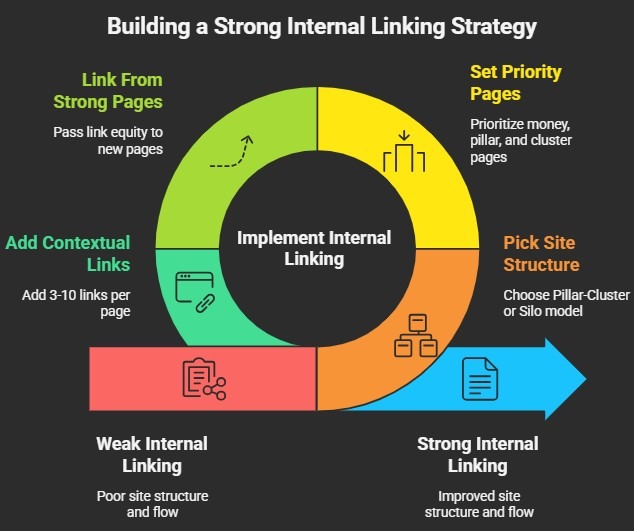
Step 1 — Pick a Site Structure Model (Pillar vs Silo)
Start with one model per content area. Use pillar-cluster for blogs and guides, and use silos for services and ecommerce categories. Then map your hierarchy as homepage → categories/services → deep pages, so priority pages stay within 2–3 clicks.
Step 2 — Set Priority Pages (Money → Pillar → Cluster)
List your money pages first, like “SEO services in Bangladesh” or “SEO services in Dhaka.” Next, pick your pillar pages, and then outline cluster posts that answer common questions. After that, link cluster → pillar and pillar → clusters to keep the topical map clear.
Step 3 — Link From Strong Pages (Pass Link Equity)
Find pages that already perform well (strong backlinks, higher clicks, or steady traffic). Then link from those pages to newer or weaker pages on the same topic, so link equity flows where you need it.
Step 4 — Add contextual links early and naturally
Place internal links where readers need the next step. Add one early when it fits, add 1–2 in the middle, and add one near the end for conversions. Finally, keep link count reasonable, often 3–10 per page, based on length and intent.
How to Fix Orphan Pages and Broken Internal Links
Orphan pages have no inward internal links, so Google may crawl and index them slowly. First, link to each important orphan page from a relevant pillar page, hub page, or category page.
Next, fix broken internal links because 404s waste crawl budget and reduce trust. Then update links that go through 301/302 chains, so they point to the final URL.
Finally, reduce click depth by linking to priority pages from hubs and top-performing posts, so users and Google reach them faster.
Anchor Text Best Practices for Internal Links (Examples)
Anchor text tells readers what they will get after the click, and it also helps Google understand the target page. So use clear, descriptive anchors that sound natural.

Anchor text rules
- Use descriptive words, not “click here.”
- Match the target page topic and intent.
- Vary anchors naturally; keep exact-match rare.
Link placement rules
- Add one link near the top when it fits.
- Add links at key decision points in the content.
- Add a next-step link near the end for conversions.
Also, when you want to build trust, link to proof pages like case studies so readers can see real results.
Bangladesh anchor examples
- “SEO services in Bangladesh”
- “SEO services in Dhaka”
- “internal link audit checklist”
Internal Linking Strategy for Bangladesh Websites (Examples)
Most Bangladesh sites run on WordPress or Shopify, so keep internal linking simple and consistent.
Blog playbook
- Build 3 pillar pages, then publish 8–12 supporting posts for each.
- Link pillar ↔ supporting posts both ways, and refresh old posts monthly with 2–3 new links.
Service site playbook
- Use a service hub, then link to each service page and trust pages (About, Contact, Service Areas).
- Add city pages for Dhaka, Chattogram, Khulna, Rajshahi, or Sylhet when you target those areas.
E-commerce playbook
- Keep category → product paths clean, and link blog guides to category pages.
- Control filters/URL parameters and keep pagination consistent.
Internal Link Audit Tools (Google Search Console Guide)
You can start with Google Search Console and a simple link map. Then you can spot weak pages and improve internal links without paid tools.

Google Search Console checks
- Links: find top-linked and least-linked pages.
- URL Inspection: Confirm priority pages can be indexed.
- Indexing/Coverage: watch soft 404 and “crawled not indexed.”
- Performance: boost pages with impressions but low clicks using internal links.
Internal link map (template)
| Page type | Link targets | Anchor examples |
| Blog post | Pillar + service | “topic clusters”, “SEO services in Bangladesh” |
| Pillar page | Clusters + hub | “orphan pages”, “internal link audit” |
| Service page | Proof + related services | “case studies”, “content marketing service” |
| Category page | Subcategories + collections | “best sellers”, “men’s shoes” |
Simple audit routine
- Weekly: add 3–5 contextual links to new posts and link them from a pillar page.
- Quarterly: fix 404s, update redirect links (301/302), and connect orphan pages.
Common Internal Linking Mistakes (And How to Fix)
Mistake 1: Menus and footers are enough
Sitewide links help discovery, but contextual links inside your content add clearer meaning. So link within paragraphs when the topic matches.
Mistake 2: One anchor text everywhere helps rankings
Repeated anchors can look forced and reduce clarity. Instead, use descriptive anchors and vary them naturally.
Mistake 3: More links always help
Too many links can distract readers and dilute focus. Therefore, keep links relevant, readable, and placed where they support the next step.
Frequently Asked Questions
How many internal links should I add to a blog post?
Use about 3–10 internal links based on length and intent. Keep at least one link to a pillar page, then add links only where they support the topic.
What anchor text should I use to avoid over-optimization?
Use descriptive phrases that match the page topic, and vary the wording naturally. Keep exact-match anchors rare.
How do I find orphan pages without paid tools?
Use Google Search Console and your sitemap, then compare with your hubs, pillars, and category pages. Add at least one inward link to each important orphan page.
What is better for SEO: pillar-cluster or silo structure?
Use topic clusters for blogs and guides, since they build topical authority. Use silos for e-commerce and large service catalogs, since they keep category relevance tight.
Which Google Search Console reports show internal linking impact?
Use Links for internal link distribution, Indexing/Coverage for crawl and indexing signals, and Performance for clicks and impressions after you add internal links.
Next Steps for Internal Linking
A strong internal linking strategy for SEO builds a site structure that ranks. It helps Google crawl and index your pages faster, and it also sends more link equity to the pages that matter. So start with a clear model, follow the money pages → pillars → clusters rule, and track changes in Google Search Console.
If you want a simple internal link map, a full audit, and a Bangladesh-ready SOP, Branding Dask can support you. Reach out when you want a practical plan that fits your website goals.

Business Growth Expert with 7+ years of experience driving scalable growth through full stack digital marketing, including SEO, SEM, paid ads, AI automation, and content led strategies.