
Fixing duplicate content in Bangladesh, especially for local eCommerce and content-heavy websites, needs a mix of technical SEO, content management, and plagiarism monitoring. Duplicate content can be internal (similar pages on your site) or external (scraped by others), and it can confuse Google, split ranking signals, and waste crawl budget.

In this guide, you will learn how to fix duplicate content step by step using canonical tags (rel=canonical), 301 redirects, and content cleanup (merge, rewrite, prune, or noindex). You will also learn how to spot issues like “Duplicate without user-selected canonical” in Google Search Console, confirm the correct page in URL Inspection, and apply Bangladesh-focused examples for WordPress archives, product descriptions, and city pages like Dhaka, Chattogram, and Sylhet.
Key Takeaways
- First, choose one preferred URL and keep every signal aligned to it.
- Use a canonical tag when you keep similar pages for users.
- Use a 301 redirect when you want one final URL.
- If pages compete, merge them or rewrite one with a different angle.
- Use noindex for thin archive pages that add little value.
- Finally, confirm the result in Google Search Console (URL Inspection).
What Is Duplicate Content in SEO and Why It Matters
Duplicate content means the same, or very similar, content appears on more than one URL. So Google must choose which version to index, and that choice may not match your goal. When duplicates spread across URLs, Google can split ranking signals. As a result, your best page may not rank, and similar pages can compete for the same keyword. Also, crawl time gets wasted on repeats, which can slow down indexing.
This issue is common in Bangladesh because many sites use WordPress and eCommerce templates, and teams publish fast. So small URL variations can create duplicates before anyone notices.
Common Causes of Duplicate Content in SEO (URL & CMS)
Duplicate content usually starts from URL settings and CMS-generated pages. So if you fix these root causes, you reduce duplicates and make how to fix duplicate content much easier.
URL variants (HTTP/HTTPS, www/non-www, trailing slash)
Small URL differences can create multiple versions of the same page, such as:
- http://example.com/page
- https://example.com/page
- https://www.example.com/page
- https://example.com/page/
Google can treat each version as a separate URL. So you should pick one preferred format (HTTPS + your www rule + one slash rule) and keep it consistent.
UTM Parameters, Filters, and Pagination Duplicates
Tracking helps marketing, yet it can create many URL versions, like:
- ?utm_source=facebook
- ?utm_campaign=ramadan_sale
- ?sort=price_asc
Filters and pagination (like page=2) can also create duplicates. So keep tracking for reporting, but guide Google to index the clean main URL instead of parameter URLs.
WordPress Archives and Other CMS Duplicate Pages
WordPress can create near-duplicate pages through:
- Tag and category archives
- Author and date archives
- Attachment pages
- Search result pages
City-based service pages in Bangladesh can help local SEO, but copied templates can cause duplication. So add unique details for each location page instead of swapping only the city name.
How to Find Duplicate Content in Google Search Console
Start with quick checks, and then confirm in Google Search Console because it shows what Google actually indexes. This helps you plan how to fix duplicate content without guessing.
Quick Free Checks to Spot Duplicate Pages
- Google: site:yourdomain.com “a unique sentence”
- Test URL variants in your browser (http/https, www, trailing slash)
Optional Tools to Find Duplicates Faster
- Screaming Frog SEO Spider, Siteliner (internal duplicate content), and Copyscape (external copying)
If you want a full SEO audit for duplicate content, our SEO services in Bangladesh can help.
Google Search Console checks
- Open Pages (Indexing) and look for “Duplicate without user-selected canonical”
- “Alternate page with proper canonical tag”
- Then use URL Inspection to compare the user-declared canonical vs Google-selected canonical
Canonical Tag vs 301 Redirect: What Should You Use?

Use this table to choose the right method for how to fix duplicate content. It keeps your fix simple, and it helps Google index the correct URL.
| Situation | Best Fix | What it does | Avoid |
| You keep similar pages for users (filters, print pages, variants) | Canonical tag | Points Google to one preferred URL | Canonical to a redirect, 404, or noindex page |
| You want one final URL for users and Google | 301 redirect | Sends users and signals to one URL | Redirect chains and loops |
| Pages compete or feel too similar | Content cleanup | Builds a stronger page | Keeping both pages unchanged |
| Low-value pages get indexed | Noindex (or cleanup) | Keeps low-value pages out of search | Using robots.txt only |
Quick Decision Flow: Canonical or Redirect?
- If users need one page → use a 301 redirect.
- If users need multiple pages → use a canonical.
- If pages feel too similar → do a cleanup (merge or rewrite).
- If a page adds little value → use noindex or remove it.
How to Add Canonical Tags to Fix Duplicate Content
A canonical tag tells Google which URL is the main version. So it works best when you keep similar pages for users, but you want one preferred URL in search.
Do
- Add one canonical tag in the <head>
- Use an absolute URL
- Keep internal links and the XML sitemap pointing to the canonical URL
Example: <link rel=”canonical” href=”https://example.com/main-page/” />
Don’t
- Don’t add multiple canonical tags on one page
- Don’t canonicalize to a URL that does not return 200 OK
- Don’t canonical to a noindex page
- Don’t mix signals (canonical and sitemap/internal links mismatch)
When to Use 301 Redirects for Duplicate Content
A 301 redirect sends one URL to another permanently. So use it when you want one final page, and you no longer need the duplicate URL.
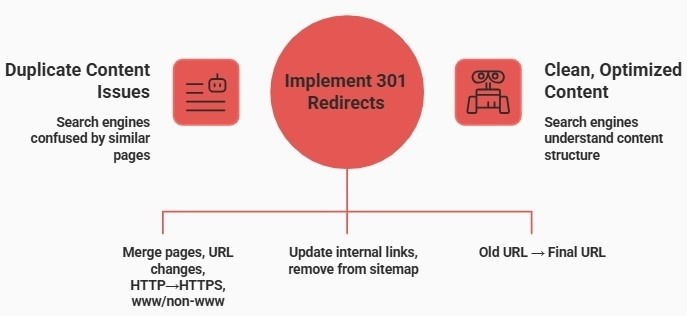
Use 301 redirects when
- You merge two pages into one
- You change URLs during a redesign or migration
- You fix HTTP→HTTPS or www rules
Redirect hygiene checklist
- Redirect old URL → final URL in one step
- Update internal links to the final URL
- Remove redirected URLs from the sitemap
- Check for redirect chains and loops
Mini example (old → new):
- Old: http://example.com/service
- New: https://example.com/service
- Action: 301 redirect old to new, then update sitemap + internal links to HTTPS
Content Cleanup to Fix Duplicate Content (Merge & Noindex)
Content cleanup helps when pages feel too similar and compete in Google. You can also check our case studies to see how fixes improve performance.
Merge Similar Pages Into One Strong Page
- Pick the strongest URL as the main page
- Combine the best sections into that page
- Then, 301 redirect the old URL to the merged URL
Rewrite Pages That Must Stay Separate
Paraphrasing alone usually fails. Instead, rewrite with a new angle and unique details.
- Change the intent (guide vs pricing vs local service info)
- Add unique local proof for each area page
- Reduce repeated template blocks
Bangladesh example:
“SEO Service in Dhaka” and “SEO Service in Chattogram” can stay separate, yet each page needs different FAQs, different process notes, and different local context.
Remove Thin Duplicate Pages (Prune)
- Remove thin pages with no traffic or sales value
- Redirect only to a close match, otherwise use 404 or 410
Noindex Low-Value Pages You Still Need
- Add noindex on the thin tag, author, date, and search result pages
Fix External Duplicate Content (Scraped or Syndicated)
- If someone copies your content, send a takedown request and keep proof of your original URL/date.
- If you syndicate content, ask partners to add a canonical link to your original page (or post a short excerpt with a link).
Check Duplicate Content Issues in Google Search Console
After you apply fixes, confirm the result in Google Search Console so you do not guess. This step shows whether Google accepts your canonical and redirect signals.

Validation checklist
- Open URL Inspection for the preferred URL
- Compare User-declared canonical vs Google-selected canonical
- Run Test Live URL, then request indexing for key pages
Fix “Duplicate without user-selected canonical”
Google found similar URLs but did not see your preferred version. So add a canonical on variants or redirect them to the main URL, and then check URL Inspection again.
Fix “Google chose different canonical than user”
This usually means mixed signals. So align internal links, sitemap URLs, and redirect rules with the preferred URL, and then test again.
Bangladesh Note: Merge Duplicate Google Maps Listings
If you see duplicate Google Maps listings for the same business, request a merge in Google Business Profile to protect local visibility.
How to Prevent Duplicate Content Problems in Future
Once you know how to fix duplicate content, the next goal is to stop it from coming back. So keep a simple routine and follow a few publishing rules.
Monthly checks (10 minutes)
- Review duplicates in Pages (Indexing)
- Spot-check key URLs in URL Inspection
Publishing rules for your team
- Use one URL format only (HTTPS + one www rule + one slash rule)
- Keep sitemaps listing canonical URLs only
- Block staging/dev sites from indexing
Frequently Asked Questions
What does “Duplicate without user-selected canonical” mean?
Should I use canonical, 301 redirect, or content cleanup?
How do I handle UTM parameters and filters safely?
How do I fix duplicate content in WordPress tags and categories?
How long does Google take to reflect canonical or redirects?
Final Steps to Fix Duplicate Content
Duplicate content can block rankings, but you can fix it with a clear process. First, find the duplicate URLs, then choose the right fix, and keep every signal aligned to one preferred URL. After that, confirm Google’s choice in Search Console using URL Inspection.
If you want help with how to fix duplicate content for a Bangladesh-based site, Branding Dask can audit duplicates, map each issue to one primary page, and guide you through verification.

Business Growth Expert with 7+ years of experience driving scalable growth through full stack digital marketing, including SEO, SEM, paid ads, AI automation, and content led strategies.